

Excelling in sales is one of the most important parts of any business. As part of digital transformation, finding the right leads and converting them accordingly are not simple tasks. The relationship between the customers and your business is also crucial to ensure the satisfaction of customers that you took time and effort to convert. This is why businesses choose efficient CRMs to track the services and follow up with the customers.
But there are many instances where CRM integration services and deployments fail their purposes. Why does this happen? We can conclude that this is because most of the business leaders are not clearly defining what success looks like to them.
This article will give you a clear framework to help you measure, track, and communicate CRM ROI and help your business process automation service.
Why Most Businesses Struggle to Quantify CRM Value
CRM value is not a topic of conversation or intense discussion in many enterprises. Even though the usage of CRM is integral, the leading team often fails to properly quantify the value.
Common Failure Modes
- Vague Success Metrics—Most businesses believe that their CRM is perfect, but at the same time they are not able to provide a number that proves it.
- Siloed Data – When different departments and their data do not interact with each other, it is difficult to connect CRM investment and its revenue.
- No Baseline—If the lead conversion rate, average deal size, and manual hours are not recorded before the CRM integration services, there is no baseline to measure the ROI.
Here are the basic steps to ensure that your business is not making these mistakes with your CRM ROI.
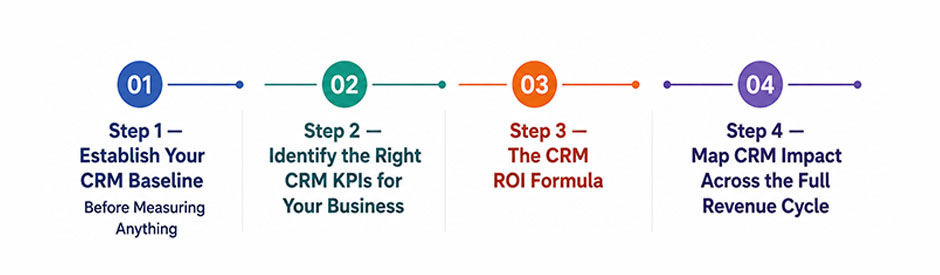
Step 1 — Establish Your CRM Baseline Before Measuring Anything
It is important to cover the major factors like the sales cycle length, lead conversion rate, churn rate of customers, and obviously manual hours that happened before the CRM was introduced to the enterprise. Without the standard baseline, your business will not have anything to measure the difference against. To put it simply, if there is no baseline, there will not be any proof that your CRM is working.
Step 2 — Identify the Right CRM KPIs for Your Business
Defining your Key Performance Indicators is crucial to measure the performance of your or the success of any systems or employees. When it comes to CRM, we can break this into two sections.
Revenue-Driven KPIs
This will cover the KPI that can measure CRM success.
- Deal close rate: It is important to have proper accounts of how many leads you got and how many were converted.
- Average deal size: The size of the deals you are having is important for calculating the revenue.
- Revenue per sales rep: The total revenue earned should be divided by the number of sales representatives to measure the average revenue generated.
Efficiency-Driven KPIs
• Time saved on manual tasks: Many manual tasks will be automated by the CRM system, and this time could be used for other important tasks.
• Lead response time: The time your sales team takes to respond to a lead will be considerably less with the help of CRM, and it will help to track this.
• Pipeline velocity: If your deals get stuck at any stage, your pipeline velocity will become slow. A good CRM can help you speed up this process.
Step 3 — The CRM ROI Formula
This is the standard formula that everyone uses to calculate the CRM ROI of any business process automation service.
CRM ROI (%) = [(Financial Gain – CRM Cost) / CRM Cost] x 100
For instance, let’s imagine that Mr. A is running a business. He is able to close 20 deals per month with an average deal value of $5000. So, his total monthly revenue from sales is $1,000,000.
Now, he is introducing a CRM and investing in it.
The annual cost for CRM is $30,000 per year. And, after 12 months with the CRM, he and his team were able to have better control of follow-ups and leads with faster responses. With such a change, he is closing 26 deals per month with the same average deal value.
We can calculate his extra revenue per month by multiplying the extra deals he did with his average deal value, which will be $30,000. Generating an extra revenue of $360,000 over the course of 12 months.
Applying this to the formula.
ROI = [($360,000 – $30,000)/$30,000] x 100
ROI = [$330,000 /$30,000] X X100
ROI = 11X100
ROI = 1100%
This is how you can ensure that your CRM is giving you the profit you and your business deserve.
Step 4 — Map CRM Impact Across the Full Revenue Cycle
CRM touches many parts of your business, and that includes revenue too. In the marketing sector, CRM will help you with bringing in and identifying quality leads. When it comes to sales, it has a major role to play in ensuring the conversions and velocity of your sales workflow. The customer success with retaining them and upselling the services could also work out with CRM.
Common Mistakes When Measuring CRM ROI
Here are some of the common mistakes every business owner makes when they measure CRM success.
- Measuring too early, before the adaptation has completely matured
- Ignoring soft ROI like time saving and data quality
- Not aligning the metrics to your business goals
PixZent: Your Strategic Partner
Being an expert in CRM integration services, PixZent can help you identify the different ways you can introduce the CRM for your business process automation service. Our team will also help you to understand the ways CRM can benefit your business and the proper way to track and monitor the CRM with your business operations. With proper implementation and migration, we ensure that there will not be any pause in your workflow. Our experts are here to help you through any problems or your doubts.
Conclusion
CRM is one of the most helpful tools for an enterprise to organize and to ensure the workflow of different departments. Many organizations are not using the full potential of its services and are not aware of the actual ROI it brings into your business. PixZent, being a digital transformation company, can easily adopt and implement the right CRM solutions for your business.
Contact PixZent today for the best business process automation service!
FAQ
A good CRM ROI is generally considered to be anything above 100%—meaning you get back more than double what you spent. Industry benchmarks suggest businesses typically see between an 8x and 13x return on CRM investment, though this varies by industry, team size, and how well the CRM is adopted across the organization.
Most businesses start seeing measurable ROI from a CRM within 6 to 12 months of full adoption. The first 3 months are typically spent on setup, training, and data migration. Meaningful improvements in deal closure rates, response times, and pipeline visibility usually become visible by the end of the first year.
The most important metrics to track are lead conversion rate, average deal size, sales cycle length, pipeline velocity, customer churn rate, and revenue per sales rep. For a complete picture, also track efficiency gains like time saved on manual tasks and lead response time — these directly impact your bottom line.