

People are always looking for easy ways to find answers to the questions. Even if they are choosing a product or a service, they want to pick the best choice in a very short time to check and choose at the end. And the AI searches and answer engines like the ChatGPT is revolutionising this for the common people.
The traditional search engines are also evolving to help the people searching by simplifying the job of researching. They are bringing AI-powered searches that can provide them condensed, synthesised answers for their queries. The ranking for a keyword for your business is also important, but you need to think a bit further about the content and craft it in a way that it could be easily understood, retrieved, contextualised, and cited by the AI. This is why SEO services, AEO services, and GEO services are like close-knit friends.
With this blog, Pixzent will give you an idea on how to optimise your website for the current trends in the AI search and answer engines to stay top on the market.
What is AI Search Optimisation?
AI search optimisation is the process of improving a website’s content, structure, technical foundation and authority. This is to ensure that it can person effectively in the search engines and AI-assisted search results. To have a complete AI search optimisation, you need the help of all three giants in the ranking field.
- Traditional SEO
- Answer Engine Optimisation (AEO)
- Generative Engine Optimisation (GEO)
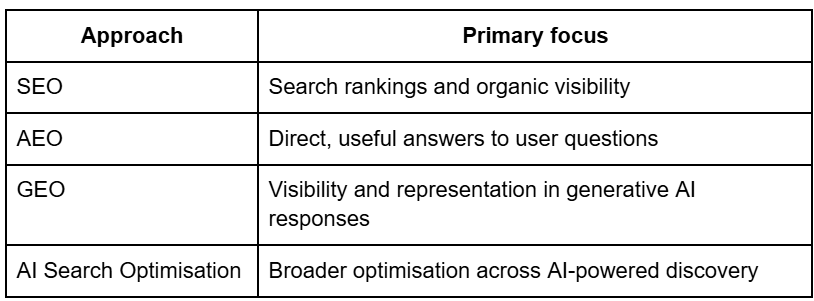
How AI Search Differs From Traditional Search
The traditional search was not a simple process. You will ask a query to the search engine, and then they will list the answers, and then you will have to look through them and finally end up choosing one that you might think is the best. This is a very lengthy and time-consuming process.
Query → Search results → User chooses a website
Now with AI-assisted search, this has become a much simpler process from the perspective of the user. You can ask a question, and then AI will retrieve information from multiple sources, and it will synthesise an answer with its reference for your question. You can choose to explore the sources of the top answers and choose the best according to the AI, which is mostly backed with solid evidence.
So, what does this mean for your content from a business perspective? The content you put in any digital sphere should be clear, contextually relevant, and well structured. There should be credible information for making them reliable for the search engines. The content should be simple and easy for the machines to understand and interpret. This goes beyond just including and matching a keyword and understanding the content together.
8 Ways to Optimise Your Website for AI Search in 2026
- Build Content Around Topics, Not Just Keywords
The content you should produce for the brand should have a solid topic and authority instead of just mentioning relevant keywords. Your content should have the supporting content around what your customers might ask the AI along with the AI search optimisation strategies.
- SEO should focus on the keyword relationships with the depth of the topic you want to publish in the digital sphere.
- AEO services, on the other hand, will be focusing on the comprehensive answers that will be related to the questions your customer base would ask the AI chatbots.
- Answer Specific Questions Clearly
AI search is extremely focused on the questions that are asked by the customers. Businesses should create sections on their websites and blogs to directly address the what, why, how, when, and like questions. We can use H2/H3 headings as the questions, and the answers to those questions should come immediately underneath them. This will improve content usability and answer-orientated discovery.
- Create Structured, Scannable Content
There should be a clear heading hierarchy with short paragraphs that have the right content and a bulleted list of content for easy understanding with numbered processes. Include comparison tables, definitions, and FAQs. The descriptive titles with the keywords and the questions that the customers might be asking. This structure will help the users to navigate the content with ease and also the system to receive the contextual signals. One thing to remember here is to not structure the whole content just for the AI. It should be primarily catering to the humans.
- Strengthen Your Technical SEO Foundation
The Answer Engine Optimisation and Generative Engine Optimisation should not become an excuse to ignore technical SEO. The SEO stops should be clearly followed by considering crawlability, indexability, internal linking, XML sitemaps, canonical URLs, mobile usability, page performance, proper metadata and all the relevant points.
- Use First-Hand Expertise and Original Information
Authority and trust are important to consider when you are preparing the content for a brand. There has to be original research that should be done and include expert insights regarding the core topic. The case studies and industry data are also important with the examples to showcase the methodologies. The first-hand experiences and author expertise will also reflect the quality of the content.
- Build Entity and Brand Authority
This is basically a move beyond the keywords. The businesses should make their brand, products, or services clearly defined across their digital presence. The people involved, locations, and areas of expertise should also be represented by all credible external sources along with your website.
- Build Strong Internal and External Context
The content should be connected strategically. There should be a logical topic ecosystem and talks within the relevance. For instance:
AI Search Optimisation → AEO → GEO → Technical SEO → Content Strategy
Along with this, there should be a strong external authority built with relevant mentions, citations, and links from credible websites. The quality and relevance should be prioritised over simply accumulating backlinks that has no connection with our topic ecosystem.
- Keep Content Fresh and Maintainable
AI search optimisation is not a one-time implementation; it requires constant updates and reviewing the content and improving the weak parts and answers in the content. The FAQs with relevant content should be added with refreshing examples. The strengthening of the internal link is linked with updating service information and removing outdated claims. The content maintenance process will be never-ending.
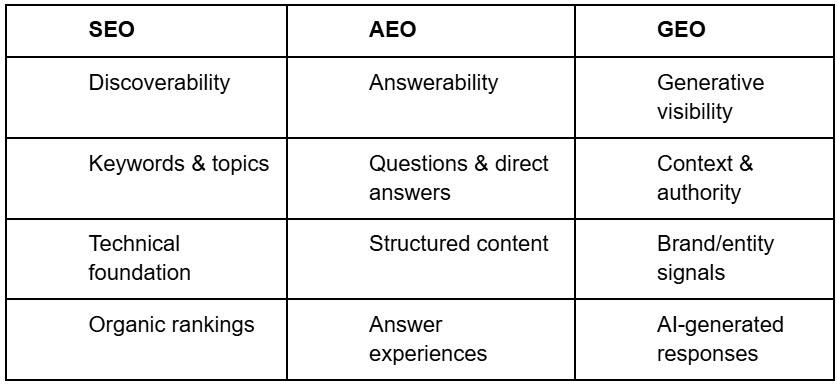
SEO vs AEO vs GEO: What Should Businesses Focus On?
Here is a simple table to understand this in simple terms.
Conclusion
AI search doesn’t replace SEO. It adds another layer to how people discover information online. Strong technical SEO, useful content, clear answers, and genuine expertise remain the foundation of good search visibility.
Pixzent’s focus is on building content that works for both people and evolving search experiences. By bringing SEO, AEO, and GEO together, businesses can create a stronger and more sustainable online presence.
Want to improve your visibility across search and AI-powered platforms? Explore PixZent’s AI search optimisation services.
FAQ
AI search optimisation is the process of improving a website so that its content can be easily discovered, understood, and used across AI-powered search and answer experiences. It includes elements of traditional SEO, content structure, topical authority, technical optimisation, and clear answers to user questions.
Yes. SEO remains an important part of AI search optimisation. Search engines and AI-powered experiences still need to discover and understand web content. A technically sound website, strong content, relevant keywords, internal linking, and good website authority continue to provide an important foundation.
SEO focuses broadly on improving a website’s visibility in search results. Answer Engine Optimisation (AEO) focuses more specifically on providing clear, direct answers to the questions people ask. A well-planned strategy can use both rather than treating them as separate approaches.