
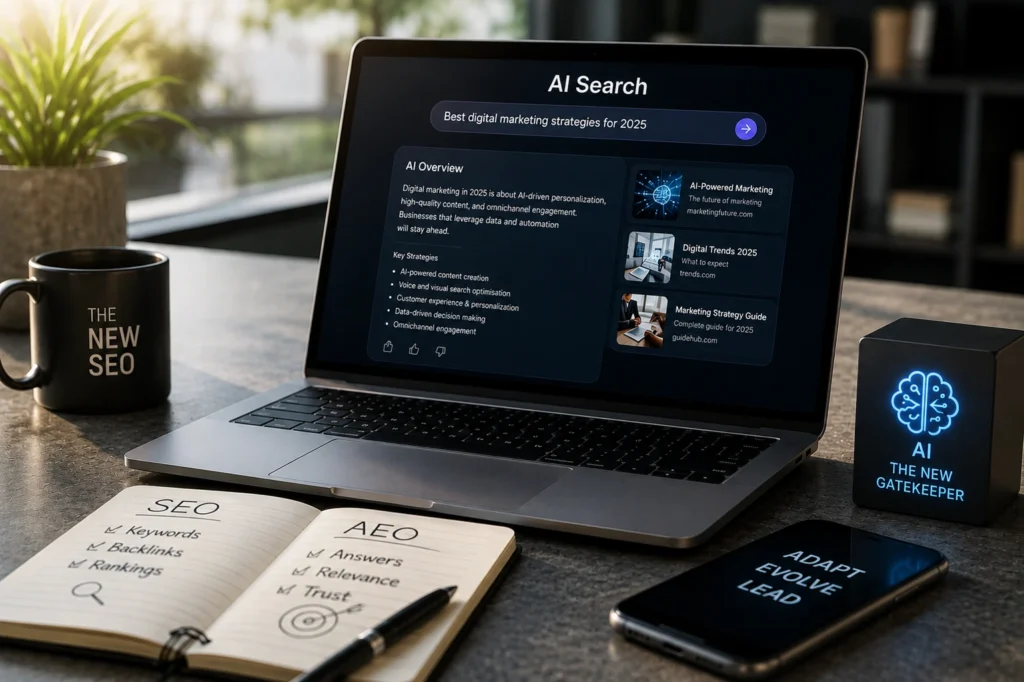
Until recently, ranking on a page of Google was considered the most important and valid point of a business. But today, this finish has drastically changed into AI search, where people ask ChatGPT, Google Gemini, and Claude their queries, and if your page is not ranked on these AI answer engines, brand visibility will be lower.
This new shift is growing, and this is why AI search optimisation is important in the new SEO services. Because traditional SEO is connected with AEO and GEO landscapes where AI transformation is taking place to help businesses get found online.
In this context, AI search optimisation combines generative engine optimisation services and answer engine optimisation services together to make brand visibility possible in AI search engines. In this blog, we are breaking down the AI search and how to make a credible preparation for your business to stay online.
Why is Traditional SEO Changing?
Traditional SEO was mainly focused on ranking a page and earning a click. This model is mainly occupied with the assumption that a human would type a query, see the links, and choose one to visit. But in the case of AI-powered search, there’s a difference. ChatGPT, Google’s AI Overviews, Gemini, and Perplexity now generate answers by summarising and synthesising information from multiple sources.
This doesn’t mean SEO is dead, but now the work has grown into two levels, like getting your page to rank and getting your content selected and quoted by AI systems. Here, both Answer Engine Optimisation (AEO) and Generative Engine Optimisation (GEO) take the step further in the new SEO services, where pages rank and get selected in the AI search engine.
What Are GEO and AEO?
Generative Engine Optimisation (GEO) and Answer Engine Optimisation (AEO) are the two major parts of SEO. Here’s how both work to build your brand visibility on AI answer engines.
- Generative Engine Optimisation
GEO is the practice of structuring and writing content so that generative AI tools can understand, trust, and cite it. Generative engines synthesise an original answer, and if your content has authority, AI will consider it for reference.
In this context generative engine optimisation services help businesses:
- Increase visibility inside AI-generated answers.
- Build content that reads as context-rich and authoritative.
- Strengthen brand credibility in AI-driven platforms.
- Brand discovery in conversational searches.
- Earn citations instead of rankings.
- Answer Engine Optimisation
Answer Engine Optimisation (AEO) focuses on a narrower scope, making the content a direct and complete answer to a specific question. AI tools prefer content that resolves a query quickly and clearly, and answer engine optimisation services make the content accurate for AI chat tools.
The benefits of AEO include:
- Winning featured snippets.
- Stronger visibility across voice search.
- Higher engagement.
- Faster answers to question-based searches.
- Content that is easy for humans and machines.
Both AEO and GEO stand as the strong pillars of making a page visible in AI search engines. GEO builds broad topical authority, and AEO sharpens this authority into a question-ready answer. These two work as a strong pair, and with a structured answer engine and generative engine optimisation services, visibility in AI-generated search engines becomes solid.
The Technical and User Intent Idea of AEO and GEO
People now search the way they speak, and instead of typing, they ask questions. AI models are trained to catch a query that is question-orientated rather than just typing “best accounting software”. In this context, content and technical foundation are important factors to align with this shift. Both content and technical factors combine together to make the brand visible on AI-generated answers.
Here’s a breakdown of how both content and technical foundation keep your page crawling with AI-generated summaries and overviews.
Business needs content that include the following:
- FAQ-style sections with real questions.
- A conversational tone rather than keyword-stuffed sentences.
- Long-tail keyword coverage.
- Logical and clear headings.
- Contextual answers instead of vague generalisations.
Technical foundations include the following:
- Schema markup that clearly labels content structure and meaning.
- Structured and clean data that AI tools can read.
- Fast-loading pages and full mobile responsiveness.
- Semantic keyword usage that reflects real topics.
- A clear content hierarchy that separates questions and answers.
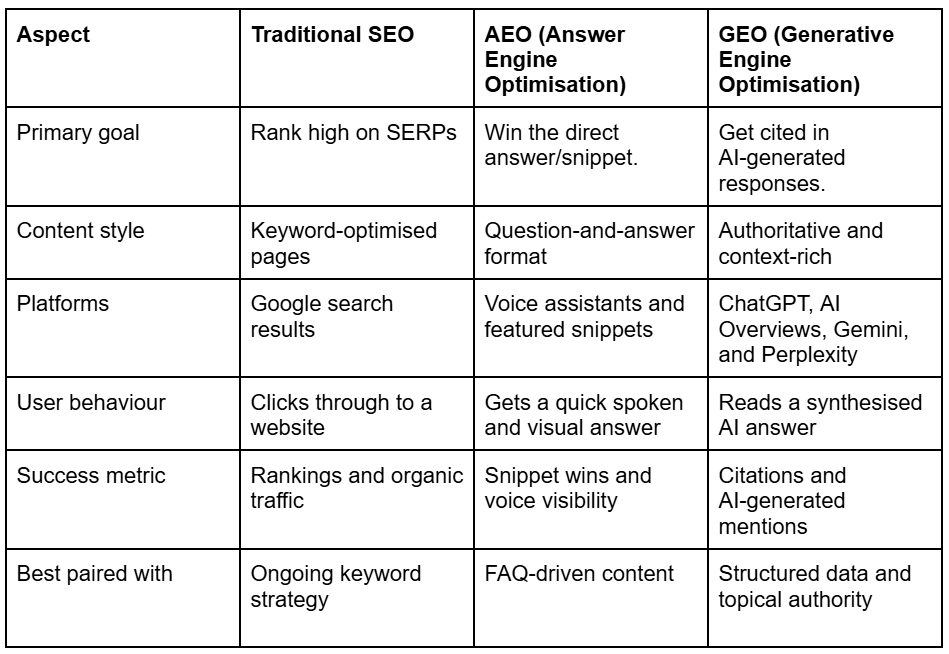
GEO vs AEO vs Traditional SEO: A Quick Comparison
The PixZent Role: Bringing AEO and GEO Together
A structured and strategy-driven generative engine and answer engine optimisation services make brand visibility solid and credible. Here SEO is not disappearing, but rather it is evolving into a new layer and keeping the brand visible. When strong technical foundations, intent-driven content, and AI-readable structure are combined, there is visibility in AI search engines, voice assistants, and generative AI platforms.
PixZent brings this combination together with a forward-looking strategy. Through generative and answer engine optimisation services, PixZent makes a connected strategy where your business gets recognised, cited, and chosen by the AI tools. PixZent prepares businesses for ranking, relevance and authority in AI search engines.
Partner with PixZent and build a search strategy that works across AI search engines.
FAQs
AI search optimisation is a combined practice of AEO and GEO, where content is optimised so it is trusted, understood, and surfaced by AI-driven search tools.
AEO is different from GEO, where the main focus is directly on answering specific questions to win snippets and voice search results. In the case of GEO, the focus is majorly on broader topical authority, so AI models can trust and take your content as reference.
Yes, because as more customers rely on AI tools to search for their queries or products, small businesses need visibility in AI-generated answers. In this context, both AEO and GEO services are important for businesses of every size.
No, AEO and GEO are not replacing SEO, but rather they are combining with it. A strong technical SEO and keyword strategy stands as the strongest foundation, and AEO and GEO bring a new layer to make brands visible in AI-generated summaries and overviews.