

Every SaaS company and e-commerce brand is now facing the same question: should we automate customer support or keep it human?
In the context of the 2026 market, understanding what customers actually need or want and building a system that delivers it actually matters. This is why the importance of customer support automation and AI chatbot integration are critical.
Today, customers have formed real preferences, and the alignment of businesses to those preferences directly supports the growth metrics.
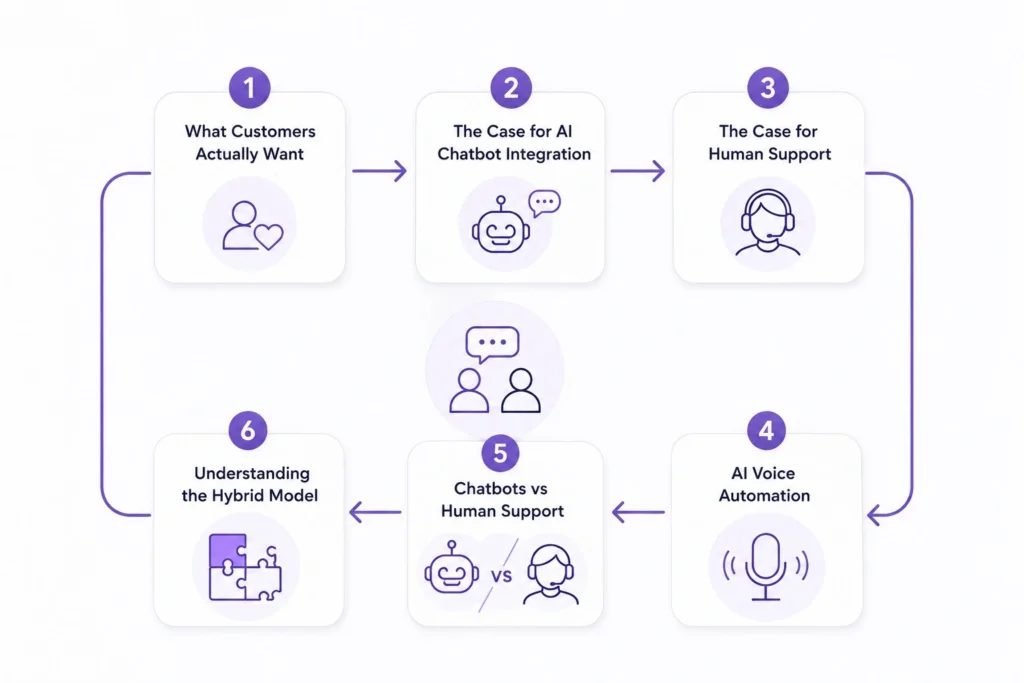
Now, this blog breaks down the below points:
- What Customers Actually Want
- The Case for AI Chatbot Integration
- The Case for Human Support
- AI Voice Automation
- Chatbots vs Human Support
- Understanding the Hybrid Model
What Customers Actually Want
Customer preferences around support have changed; for example, they use chatbots for simple queries (order status, password resets or plan details). Nowadays customers want their queries to resolve instantly without a wait.
At the same time, most of the customers want human escalation. In this context, the experience then focuses on being served by a smart system that respects the time of the customer, which is significant and connects to customer satisfaction.
| Key Note: The difference between an automated chatbot and human support is a critical factor for SaaS companies because the customers are often technically minded and time-sensitive. |
The Case for AI Chatbot Integration
Human support is still an important factor because it can’t be replaced in other considerations. When you have technical failures, emotionally charged situations, and account disputes, human judgement and empathy play a major role in it.
78% of customers prefer human support because when they face emotionally sensitive issues, they rely on human support rather than machine thought. For SaaS businesses, building a long-term relationship with clients is extremely relevant, and through human touchpoints, trust and reliability are delivered. It matters in the onboarding process, escalations, and renewal, because a support experience from humans feels much better than an automated conversation.
Key Note: Human agents are also better at reading between the lines. When a frustrated customer asks for a technically related factor, a good support agent can recognise the issue properly and turn the conversation into a better outcome. In this context, a chatbot or a customer support automation without a proper design cannot deliver this effect. |
AI Voice Automation: The Layer that Most Brands Miss
Text-based chat is there, but what’s more interesting to customers now is the integration of AI voice automation. As automation is significantly shifting towards better business handling, automated voice handles issues and inbound calls in a better way with the right context and conversion.
E-commerce businesses demand a high volume of customer calls, returns, and seasonal peaks, which require a responsive team and effect. For an effective delivery of customer support, the integration of AI voice automation services builds a meaningful advantage. For SaaS companies, this is also an effective way to deliver responsiveness without enterprise-level headcount.
Key Note: Customer support automation through voice AI is still not used properly. When you adapt to the integration of voice AI for your customer support, it will lead to a meaningful advantage. Through reliable and effective AI voice automation services, the right integration of smart systems in customer support will be delivered. |
A Side-by-Side Breakdown of Chatbots and Human Support
Let’s look into how AI chatbots and human support connect and matter to SaaS and e-commerce teams here.
| Factor | AI Chatbots | Human Support |
| Availability | 24/7 & instant response | Business hours depend on the customer queue. |
| Best for | Repetitive and high-volume queries | Complex and sensitive issues |
| Cost | Low-fraction of human agent cost | High training and infrastructure |
| Resolution speed | Immediate for standard queries | Varies from minutes to days |
| Customer preference | 67% prefer simple queries. | 76% prefer complex issues. |
| Scalability | Handles spikes without any added cost | Requires hiring to scale |
| Personalisation | AI-based and improves rapidly | Natural empathy and judgement are high. |
| Escalation capability | Needs human handoff pathway | Is the handoff |
| First contact resolution | 61% (pure AI) | Higher with the hybrid model (78%) |
| Customer satisfaction | Strong when expectations are set | Strongest for high-stakes moments |
Understanding the Hybrid Model: Where the Real Results Are
The combination of AI automation and human escalation offers reliable results. Studies have shown that this hybrid model outperforms the pure AI approach by 40% and delivers key satisfaction to customers.
Here’s how a hybrid model works:
- AI Handles the First Layer
This is where greeting, qualifying, and resolving queries of customers are conducted. Through sentiment analysis, the complexity of customer requests is studied properly to determine whether the requests need human interaction or not.
2. Handoff to Human Agent
The structured understanding of queries through AI detects if there is any frustration or complexity. From the analysis, handoff to the human agent will be activated with the gathered context of the customer request. They pick up from this prequalified conversation about AI to resolve the matter effectively.
This combined approach improves productivity by 45% and drives a 23% improvement in customer satisfaction. The integration of customer support automation with this hybrid model is a competitive and effective one for both SaaS and e-commerce brands.
Build the Right System with PixZent
Right business behaviour is the core factor of every brand, and PixZent delivers the right AI chatbot integration and customer support automation to set a clear business outcome. Through a structured implementation of automation services of AI voice automation for call handling, tier-one support, or design of a hybrid model, contribute to business scalability and growth in today’s competitive market.
Rethink your customer support and set up smart coverage with Pixzent.
FAQs
Automate customer queries and requests that are highest in volume or repeated ones. This includes FAQs, account access, and billing basics because these have the lowest risk in automation.
Yes, automation of customer support is a good thing for improving customer satisfaction. This eventually leads to business growth and scalability.
It depends on what customers actually request. For example, customers who have transactional questions mostly prefer the speed of chatbots, and for sensitive issues, human support is still needed.
AI voice automation is focused on the handling of phone interactions with the use of natural language. The process of AI voice automation includes greeting callers and collecting information. Resolving issues and connecting to the agents to further actions if needed.
The typical timeline for getting best results from custom support automation ranges from 60 to 90 days. A well-scoped implementation delivers the best results at this time range, and on the basis of real interaction data, customer satisfaction will make an improvement