
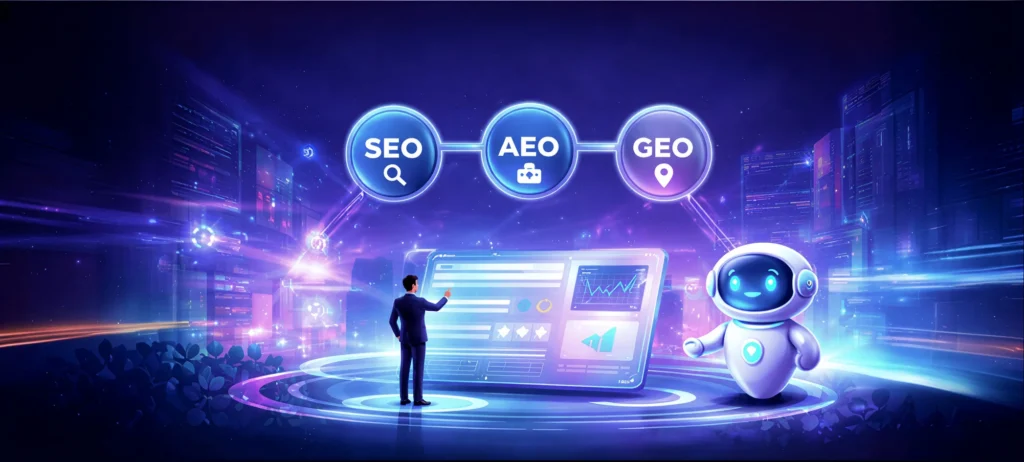
The way people search and find the best service providers is changing. The current generation are not just searching on Google or other search engines. The potential customers in 2026 are very knowledgeable about AI and its usage. It is easier to ask AI search engines, as they will collect, summarise and recommend our queries, which makes decision-making a very easy task.
As the traditional Search Engine Optimisation (SEO) is the foundation of all the search engine results, the business owners can never stop doing it. Then what can we do differently? Well, SEO has to be working alongside Answer Engine Optimisation (AEO) and Generative Engine Optimisation (GEO). This is one of the strategic shifts that you should adopt to make your audience consider you.
This blog is exploring how SEO, AEO, and GEO complement each other in the current age of AI and how businesses can leverage the best of these three for visible growth in 2026.
In 2026, SEO ensures your content is discoverable by search engines, AEO structures your content to be selected as direct answers by AI tools, and GEO helps AI systems reference and summarise your brand in generated responses. Together, they determine whether a business is found, trusted, and recommended by AI-powered search platforms.
The Evolution of Search in an AI-First World
Search behaviour has changed drastically over the past few years. It is not a secret that users, including you and me, are searching for things in the search engines. The users are asking directly to the AI assistants. And, it has to be noted that the results in the SEO and AI assistants are completely different.
AI-powered platforms now:
- Interpret search intent rather than just keywords
- Pull answers from multiple trusted sources
- Generate responses instead of displaying ten blue links
This has made the entrepreneurs and brands panic about their visibility in the AI platforms. Indexing in search results is not enough. The brand needs to understand the AI systems and the psyche of the customers to be trusted by these platforms.
What Is SEO in the Age of AI?
SEO in the age of AI focuses on building clarity, authority, and technical trust so that both search engines and AI models can understand, evaluate, and rank content accurately.
SEO is still standing as the foundation of the digital sphere to ensure visibility, but it has evolved and matured. In 2026, SEO is focusing more on building clarity and authority over the gaming algorithms.
Key AI SEO Priorities in 2026:
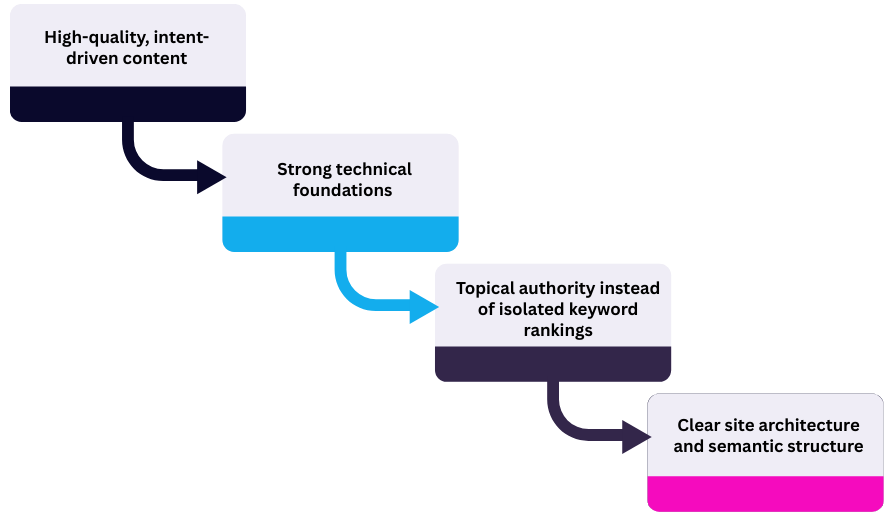
- High-quality, intent-driven content
- Strong technical foundations (Core Web Vitals, mobile performance, security)
- Topical authority instead of isolated keyword rankings
- Clear site architecture and semantic structure
Search engines increasingly rely on AI models to evaluate content quality. So, SEO is overlapping itself with content strategy, UX, and even digital credibility.
Understanding Answer Engine Optimisation
AEO focuses on optimising content in order to make it directly answerable by AI systems, voice assistants, and featured snippets.
It is time to ask how a business can become the answer to the questions of the customer.
AEO in Action:
- FAQs structured for real answers for the user queries
- Concise and clear explanations written in natural language
- Use of schema markup to help machines understand the context of content
- Content optimised for voice and conversational queries
As most of the users are now using AI platforms for searches and doubts, it is important to be present in these platforms and not just on the traditional result page.
What Is Generative Engine Optimisation (GEO)?
GEO is especially critical as AI platforms increasingly recommend businesses, not websites, based on trust, consistency, and contextual authority.
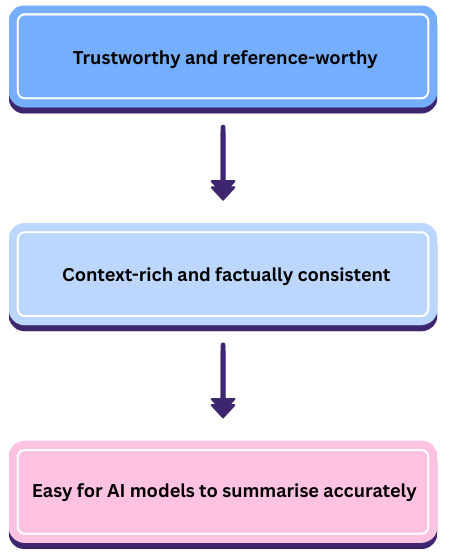
GEO, or Generative Engine Optimisation, is the newbie in the optimisation family. They are designed for the AI platforms and models that will generate content. These systems are not just retrieving information. GEO synthesises the information and content and ensures that your brand’s content is:
- Trustworthy and reference-worthy
- Context-rich and factually consistent
- Easy for AI models to summarise accurately
GEO Optimisation Includes:
- Publishing authoritative, well-sourced content
- Maintaining consistent brand messaging across platforms
- Creating content that AI can quote, paraphrase, or reference
- Optimising for context, not just keywords
The current situation makes it difficult for the brands if they are not recognised by AI tools, creating a gap between the potential customers and the brand.
How SEO, AEO & GEO Work Together
These three strategies are not fighting each other, but they are complementary.
- SEO will help you build the foundation by helping you with discoverability, structure, and authority.
- AEO ensures your visibility in the answers in AI platforms and voice-driven queries.
- GEO positions your brand inside AI-generated insights and recommendations.
So, we can say that SEO, in the age of AI, is getting your content into the system, AEO is making it the preferred answer, and GEO is ensuring it fits AI-generated content.
Why This Matters for Digitally Transforming Businesses
Digital transformation for the business has been inevitable and often focuses on automation, data, and other platforms. They forget about the visibility, which is also critical. When your solutions become invisible to your clients, your brand is missing out on many potential buyers. This is where companies like Pixzent play a huge role.
The Role of Pixzent in the AI-Driven Digital Era
Pixzent operates at the intersection of digital transformation, AI-ready platforms, and search visibility. By aligning technology, data, and user experience, Pixzent enables businesses to be discoverable not only on search engines, but also within AI-generated recommendations and insights.
In an AI-first world, transformation is not just internal—it’s external. From modern digital experiences to data-driven ecosystems, Pixzent enables organisations to remain relevant, visible, and competitive as AI reshapes how people discover and trust brands.
Make sure that your brand is becoming the answer for your clients!
FAQ
- What is the difference between SEO, AEO, and GEO?
SEO is the traditional search engine optimisation that focuses on improving the website visibility through quality content, technical optimisation, and authority building.
AEO, or Answer Engine Optimisation, ensures that your website content is structured as direct answers that would appear in AI tools, voice searches, and other snippets.
GEO is Generative Engine Optimisation that actually helps the brands to get referenced and summarised by the AI systems and platforms as a response to the user queries.
- Is SEO still relevant in 2026?
SEO is the foundation of the search engine results, so yes, it is relevant in 2026. AEO and GEO are not replacing SEO but take support of it to ensure the content is discoverable, credible, and technically sound.
- How does Pixzent help businesses adapt to AI-driven search?
Pixzent supports businesses through end-to-end digital transformation, enabling modern digital platforms, scalable systems, and future-ready strategies. By aligning technology, data, and user experience, Pixzent helps organisations stay visible, relevant, and competitive in an AI-first digital landscape.
Can AI tools like ChatGPT recommend businesses directly?
Yes. AI platforms increasingly recommend businesses by analysing content clarity, authority, consistency, and structured answers. Brands that optimise for SEO, AEO, and GEO together are more likely to be referenced or suggested in AI-generated responses.

